
A loose dental implant can feel alarming, especially when the implant has been comfortable for months or years. You may suddenly notice movement while chewing, hear a small clicking sound, feel that the tooth is “wobbly,” or realise that your bite feels different.
But something important is often missed: the dental implant itself may not be the part that is loose.
Sometimes the movement comes from the implant crown, the abutment, or the screw that connects the restoration to the implant. These problems are different from movement of the implant fixture inside the jawbone.
The difference matters because a loose implant crown may be a mechanical problem that your dentist can often address, while actual movement of the implant fixture requires prompt clinical assessment.
If your dental implant feels loose, avoid repeatedly testing it with your tongue or fingers. An implant dentist needs to determine exactly which component is moving.
What Parts Make Up a Dental Implant Tooth?
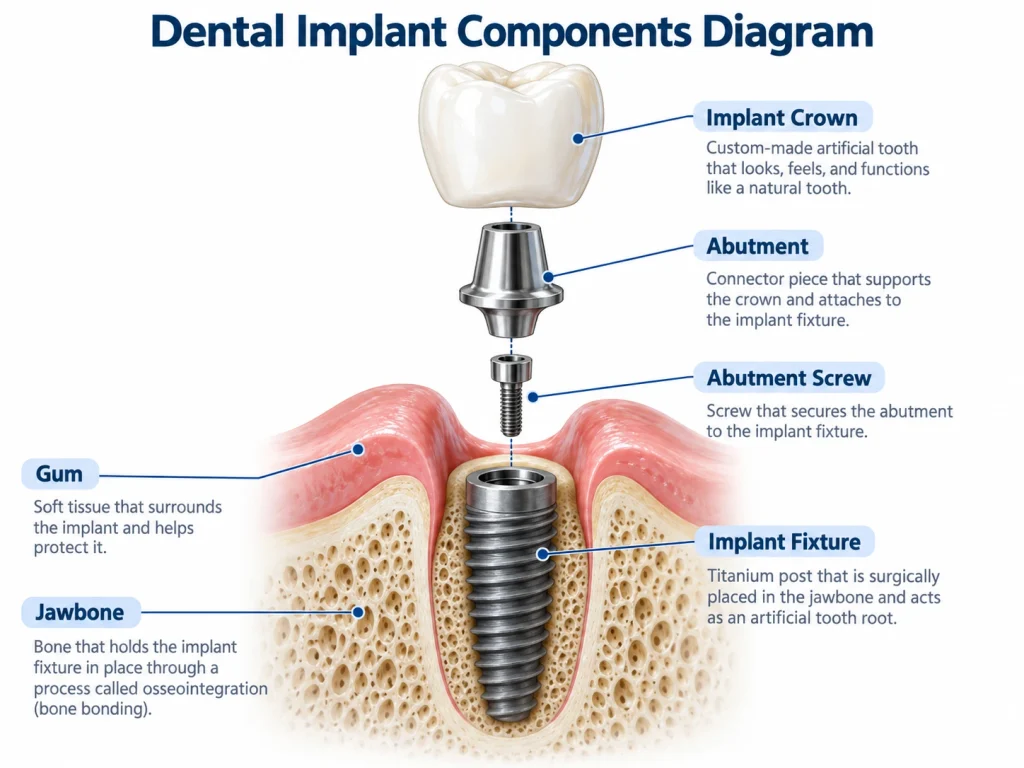
Understanding the parts makes it easier to understand why an implant-supported tooth can feel loose.
A typical single dental implant restoration has three main components.
The implant fixture sits inside the jawbone and acts as an artificial tooth root. An abutment connects to the implant. The visible dental crown then attaches to the abutment or directly to the implant system, depending on the design.
The American Academy of Periodontology describes a dental implant as the artificial root placed in the jaw, while the replacement crown forms the visible tooth above it.
This means movement can occur at different levels.
The crown may move while the implant remains firmly integrated with the bone. A screw between the components may loosen. A cement-retained crown may lose retention. Less commonly, the implant fixture itself may become mobile.
Those situations can feel similar to a patient but require very different treatment.
What Does a Loose Implant Crown Feel Like?
A loose implant crown may feel as though the artificial tooth moves slightly when you bite or touch it with your tongue.
Some patients notice a clicking sensation. Others feel that the crown rocks slightly or that their bite has suddenly changed.
The implant below the gum may still be completely stable.
One possible cause is loosening of the abutment or prosthetic screw. Screw loosening is a recognised mechanical complication of implant-supported crowns and has been repeatedly documented in implant research.
Another possibility is loss of retention in a cemented implant crown.
The important point is that a moving crown does not automatically mean the dental implant has failed.
However, it still needs professional attention. Continuing to chew heavily on a loose restoration may place additional stress on the crown, screw, abutment or implant connection.
What Does an Actual Loose Dental Implant Feel Like?
A true loose dental implant means the implant fixture itself is moving within the jawbone.
That is different from movement limited to the crown or abutment.
Dental implants depend on a process called osseointegration, where the surrounding bone forms a stable connection with the implant surface. Implant mobility can indicate that this stable connection has been lost or did not develop adequately.
Research on implant failure identifies mobility as an important clinical sign when an implant has failed to integrate properly. Infection and progressive bone loss may also be associated with implant failure.
A patient cannot always tell which component is moving.
The sensation may simply feel like the whole tooth is loose.
That is why you should not try to diagnose the problem by repeatedly pushing or wiggling the implant.
Loose Implant Crown vs Loose Implant – What Is the Difference?
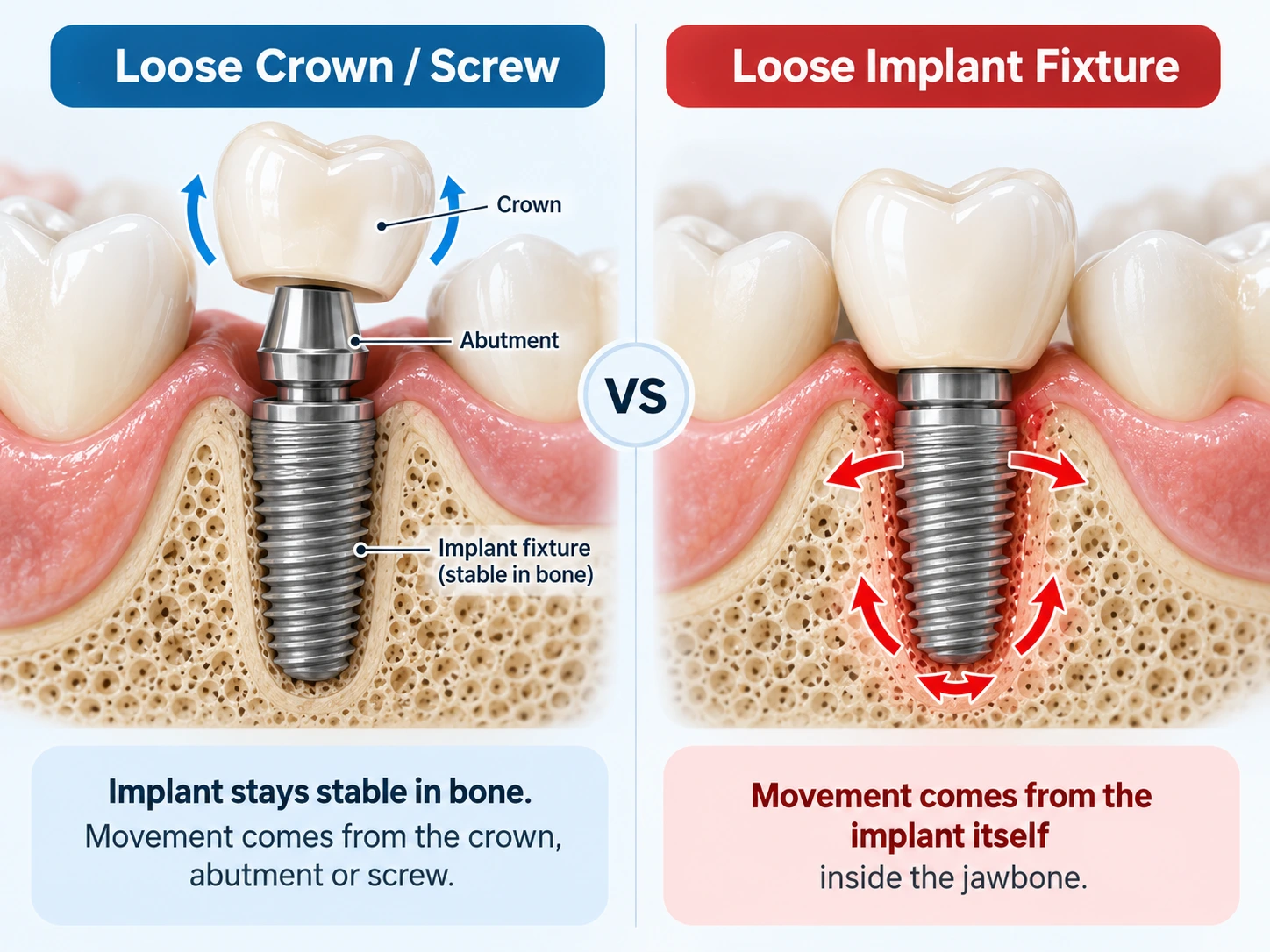
The most useful distinction is where the movement comes from.
With a loose implant crown, the implant fixture may remain stable in the bone while the restoration above it moves.
With a genuinely loose dental implant, the fixture itself moves.
A dentist can often determine this by examining the crown, checking the implant-abutment connection, evaluating your bite and taking dental X-rays when needed.
The dentist may also check the surrounding gum and bone for signs of inflammation or bone loss.
From a patient’s perspective, the symptoms can overlap. A clicking crown can feel similar to a moving implant. For this reason, feeling movement alone is not enough to identify the cause confidently.
The safest approach is to have the implant assessed.
Why Can an Implant Crown or Screw Become Loose?
Implant crowns handle biting forces every day.
Over time, repeated forces can affect the screw joint connecting the implant restoration.
Research has linked screw loosening with several mechanical factors, including bite forces, non-axial loading, restoration design and parafunctional habits such as clenching or grinding.
The problem may also appear after normal long-term function.
This does not necessarily mean anything was done incorrectly. Implant restorations are mechanical structures operating in a demanding environment.
However, repeated loosening deserves investigation.
Simply tightening the same component again and again without identifying the reason may not solve the underlying problem. Recent research has also examined how repeated tightening and loosening can affect the implant-prosthetic screw joint.
Your dentist may therefore evaluate the screw, crown, implant connection, contacts between teeth and the way your teeth meet when you bite.
Can Teeth Grinding Make an Implant Crown Loose?
It can contribute.
People who clench or grind their teeth can generate substantial forces, especially while sleeping.
Unlike natural teeth, dental implants do not have the same periodontal ligament around the root that natural teeth have. This changes how forces are transferred through the implant restoration.
If you grind your teeth, your dentist may examine whether excessive bite forces are contributing to repeated screw loosening, crown damage or other mechanical problems.
You may also notice wear on nearby natural teeth, jaw tightness or morning muscle discomfort.
Do not assume grinding is the cause, though. Your dentist should examine the complete implant system before reaching a conclusion.
Is a Loose Implant Crown an Emergency?
It should not be ignored.
A slightly moving implant crown may not always require emergency hospital care, but you should arrange a dental assessment promptly.
Until then, avoid chewing hard foods on that side.
Do not attempt to tighten the implant yourself. Do not use household glue, dental adhesive or other materials to secure the crown.
If the crown becomes completely detached, keep it clean and bring it with you to the appointment rather than trying to replace it yourself.
Seek more urgent dental attention when movement occurs together with significant pain, swelling, pus, persistent bleeding, a bad taste, trauma or rapidly increasing discomfort.
What If the Implant Itself Is Moving?
Movement of the implant fixture requires professional assessment as soon as practical.
An implant that has integrated successfully with the jawbone should not behave like a loose natural tooth.
Your dentist needs to determine why the movement is occurring.
Possible concerns can include loss of osseointegration, progressive bone loss, infection around the implant or other biological or mechanical complications.
This cannot be diagnosed accurately from symptoms alone.
The dentist may need clinical examination and dental imaging. Depending on the situation, an X-ray or three-dimensional CBCT scan may help evaluate the bone and surrounding structures.
Immediate-loading implant guidance from the International Team for Implantology also emphasises the importance of clinical assessment and imaging, including CBCT where appropriate, when implant stability and treatment conditions need evaluation.
Can a Loose Dental Implant Be Saved?
That depends entirely on what is actually loose and why.
If the movement comes from the crown or prosthetic screw while the implant itself remains healthy and stable, your dentist may be able to repair or replace the affected restorative component.
Clinical literature describes abutment screw loosening as a common prosthetic complication of single implant crowns and one that can often be managed restoratively.
If the implant fixture itself has become mobile, the situation is more complex.
Your dentist must assess the implant, surrounding bone and soft tissue before discussing possible next steps.
The earlier you have unexplained movement checked, the easier it is to avoid additional damage to components that may still be healthy.
What Will an Implant Dentist Check?
The appointment usually begins with one simple question: what exactly is moving?
Your dentist will examine the implant crown and surrounding gum. They may check whether movement is limited to the crown or extends to the fixture.
The dentist can also assess your bite and look for signs of excessive force, damaged porcelain, inflammation, bleeding or infection.
Dental imaging may help evaluate the bone surrounding the implant.
If the crown is screw-retained, the dentist may inspect the screw connection. If it is cement-retained, the dentist may investigate whether the crown has lost retention or whether the abutment screw underneath has loosened.
The treatment therefore depends on the diagnosis rather than the symptom alone.
Loose Dental Implant in Dubai – When Should You Book an Appointment?
If a dental implant starts moving unexpectedly, do not wait until it becomes painful.
Mechanical implant complications are not always painful at the beginning.
A crown that has started moving may continue to function temporarily, which can tempt patients to ignore it. But early assessment may prevent damage to the crown, screw or other implant components.
Patients searching for a dental implant specialist in Dubai, implant dentist Dubai, or help with a dental implant problem in Dubai can arrange an implant assessment at Crossroads Dental Clinic.
The clinic provides implant dentistry at its Deira and Sheikh Zayed Road locations.
Dental Implant Assessment in Deira Dubai
Patients looking for dental implants Deira, an implant dentist in Deira, or a dentist near Deira City Centre can visit Crossroads Dental Clinic in Port Saeed, opposite City Centre Deira Metro Station.
This can be especially helpful if an existing implant suddenly feels different, the crown moves during chewing or you notice discomfort around the implant.
Bring any previous implant records you have, particularly if the implant was placed elsewhere.
Knowing the implant system can sometimes help the dentist when restorative components need to be assessed.
Dental Implant Assessment on Sheikh Zayed Road
Crossroads Dental Clinic also provides implant care from its Sheikh Zayed Road branch beside Emirates Towers Metro Station.
Patients searching for dental implants Sheikh Zayed Road, an implant dentist near Emirates Towers Metro, or implant care around DIFC, World Trade Centre, Business Bay or Downtown Dubai can arrange an assessment there.
Both Crossroads locations provide dental implant services as part of their multidisciplinary dental care.
What Should You Do If Your Dental Implant Feels Loose?
Do not panic, but do not ignore it.
A moving implant tooth does not automatically mean the implant has failed. The problem may come from the crown, screw or another restorative component.
Avoid chewing heavily on the affected side and resist the temptation to keep testing the tooth.
Most importantly, arrange an assessment with an implant dentist.
If you have a loose dental implant, loose implant crown, clicking implant tooth or sudden change in your bite, Crossroads Dental Clinic can assess the implant and identify which component is causing the movement.
The goal is simple: diagnose the problem accurately before deciding what needs to be repaired.
Frequently Asked Questions About Loose Dental Implants
It can be difficult to tell at home. A crown or screw may move while the implant fixture remains stable. A dentist needs to examine the components and may take an X-ray to identify the source of movement.
No. An implant-supported crown should feel stable during normal chewing. New movement, clicking or rocking should be checked.
Yes. Screw loosening is a recognised technical complication of implant-supported restorations.
Sometimes the issue involves a loose screw, but the cause should also be investigated. Repeated loosening may indicate bite, component or restoration-related factors.
It is safer to avoid hard chewing on that side until your dentist examines it.
Not necessarily. What feels like implant movement may actually come from the crown or screw. Actual mobility of the implant fixture, however, requires prompt clinical assessment.