
A severe toothache can make you want the fastest possible solution. But when a tooth becomes deeply decayed, infected, broken, or painful, the first question should not always be, “Can you remove it?” Instead, your dentist will ask whether the tooth still has a predictable chance of functioning well.
The decision between root canal or extraction depends on more than pain alone. Dentists examine the remaining tooth structure, infection, cracks, gum health, bone support, and whether the tooth can support a strong final restoration.
At Crossroads Dental Clinic in Dubai, patients can receive assessment for root canal treatment, tooth extraction, dental infections, and urgent tooth pain at the Deira and Sheikh Zayed Road branches. The aim is to understand the condition properly before deciding whether to preserve or remove the tooth. Crossroads currently lists both root canal treatment and tooth extraction among its dental services.
Root Canal or Extraction: What Is the Main Difference?
A root canal aims to keep your natural tooth.
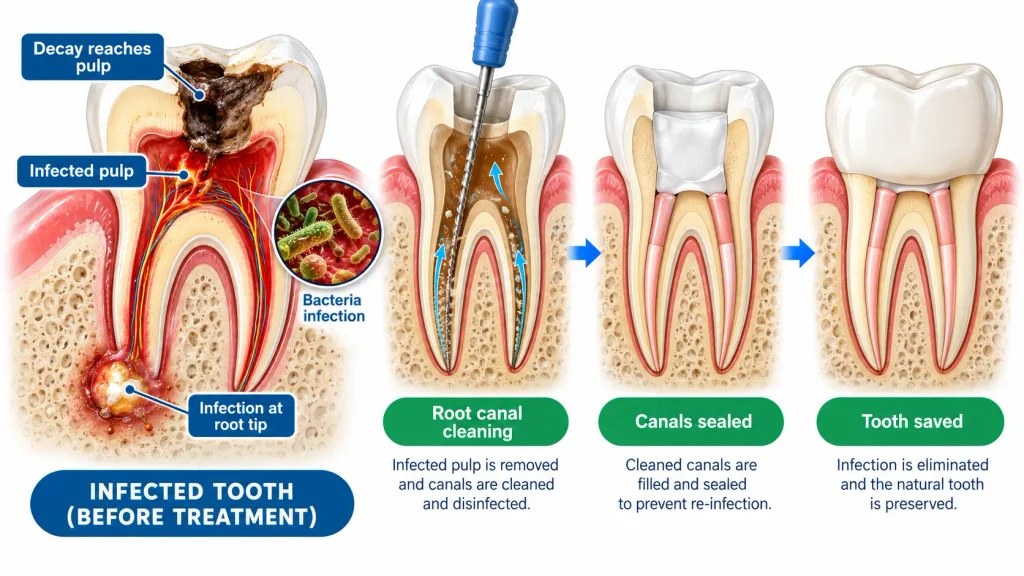
During root canal treatment, the dentist removes inflamed or infected tissue from inside the tooth. The dentist then cleans, disinfects, shapes, and seals the root canal system. After that, the tooth needs a suitable restoration to protect it and restore function.
Clinical endodontic guidance describes root canal treatment as an established way to treat inflamed or infected pulp while helping the tooth remain functional. Wiley Online Library
A tooth extraction takes a different approach. Instead of treating the inside of the tooth, the dentist removes the entire tooth from its socket.
Extraction can be the correct treatment when saving the tooth would not provide a predictable result.
The important point is simple: root canal treatment treats the diseased tooth, while extraction removes it.
When Can a Dentist Save a Tooth With Root Canal Treatment?
Dentists often recommend root canal treatment Dubai patients need when the pulp inside a tooth has become severely inflamed or infected but the tooth still has enough healthy structure and support.
Deep decay is one common cause. Bacteria can travel through a cavity and reach the dental pulp. Trauma can also damage the nerve even when the outside of the tooth does not look badly broken.
A root canal may also help when a tooth develops an infection around its root.
However, the presence of infection does not automatically mean that the dentist must remove the tooth.
The real question is whether the dentist can clean the root canal system and restore the tooth so it can continue to function.
The American Association of Endodontists encourages preservation of natural teeth when treatment can provide a predictable result.
How Does a Dentist Decide If Your Tooth Is Restorable?
A dentist does not make the root canal or extraction decision by looking at an X-ray alone.
The clinical examination matters just as much.
First, the dentist checks how much healthy tooth remains above and below the gum line. A root canal may successfully remove infection, but the tooth still needs enough structure to hold a filling, crown, or another final restoration.
The dentist also checks for cracks.
Some cracks affect only part of the tooth and may still allow treatment. Others extend deep into the root and can seriously affect the tooth’s prognosis.
Gum and bone support also matter. A tooth needs healthy supporting tissues to remain stable.
Your dentist may therefore assess tooth structure, crack location, mobility, gum pocket depth, bone level, infection, and the tooth’s role in your bite before recommending treatment.
This is why two patients with similar tooth pain may receive completely different treatment plans.
What Tests Help Dentists Decide?
The first step is usually a clinical examination.
Your dentist may tap the tooth gently, examine the gums, test the bite, and check whether hot or cold triggers a response.
Dental X-rays help show the roots and surrounding bone. They can reveal decay, infection around the root, previous dental work, and other changes that may not be visible during a normal examination.
In selected cases, the dentist may recommend 3D CBCT imaging. CBCT can provide additional information about complex root anatomy, surrounding bone, and other structures.
However, imaging forms only one part of the diagnosis. Dentists combine scan findings with symptoms and clinical tests before making a treatment recommendation.
When Is Tooth Extraction the Better Option?
Sometimes a tooth simply cannot provide a predictable foundation for long-term treatment.
A dentist may recommend tooth extraction Dubai patients need when very little healthy tooth structure remains.
A severe fracture can also change the treatment plan. A crack that extends deeply through the root can make predictable restoration difficult.
Advanced gum disease may cause another problem. If a tooth has lost too much supporting bone and has significant mobility, root canal treatment cannot replace the missing periodontal support.
The dentist may also recommend extraction when decay extends too far below the gum or when the tooth cannot support a reliable restoration.
Extraction in these situations does not mean that root canal treatment “failed” as an option. It means the tooth itself does not have a reasonable restorative prognosis.
Crossroads Dental Clinic also provides both simple and surgical extraction depending on the position and condition of the tooth.
Can an Infected Tooth Still Be Saved?
Often, yes.
A dental infection does not automatically make a tooth hopeless.
Root canal treatment specifically targets infection within the root canal system. The dentist removes infected tissue, cleans the canals, and seals them to reduce the chance of bacteria returning.
What matters is whether the rest of the tooth remains restorable.
An infected tooth with strong bone support and enough remaining structure may still have a good treatment option. A tooth with severe structural damage may not.
That distinction matters for anyone searching for infected tooth treatment Dubai or treatment for a dental abscess Dubai.
Do not wait for severe swelling before seeking care. Earlier assessment can give your dentist more options.
Does Severe Tooth Pain Mean You Need an Extraction?
No.
Pain tells your dentist that something needs attention. It does not tell them which treatment you need.
An inflamed dental pulp can cause strong, lingering pain. An infected tooth can also become extremely sensitive to pressure or biting.
In some cases, root canal treatment can address the source of that pain while preserving the tooth.
On the other hand, some badly damaged teeth cause surprisingly little discomfort.
That is why pain intensity alone cannot determine whether the dentist should save or remove a tooth.
Patients experiencing severe toothache Dubai should arrange an examination instead of waiting for the pain to disappear.
If you develop rapidly increasing facial swelling, fever, difficulty swallowing, or difficulty breathing, seek urgent medical or dental attention.
What Happens After a Root Canal?
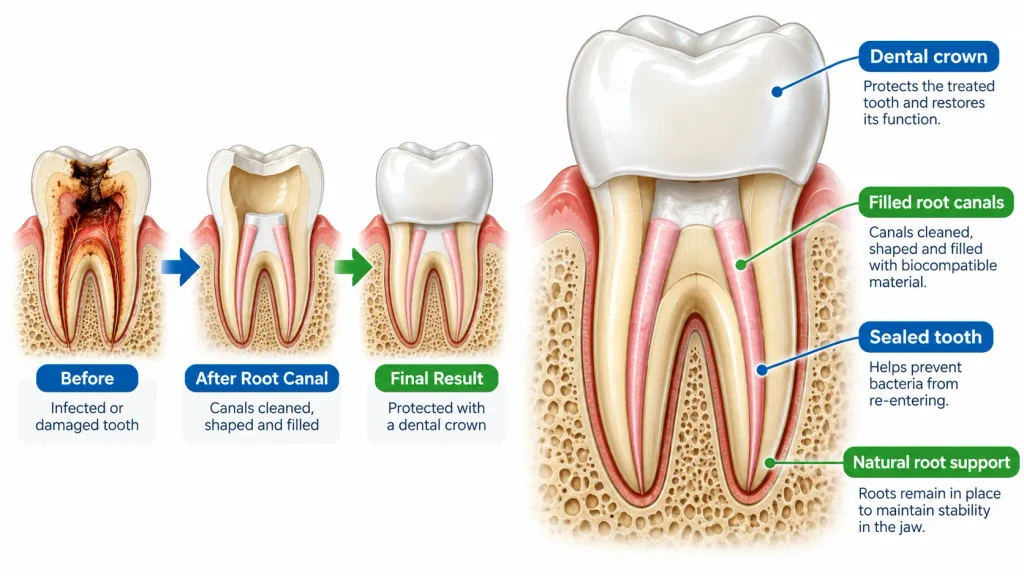
Saving the tooth does not end when the dentist finishes cleaning the canals.
The final restoration plays a major role.
Teeth that have undergone root canal treatment can already have significant structural loss from decay, cracks, or previous fillings.
Depending on the tooth, the dentist may recommend a filling, onlay, or crown to protect it during chewing.
This is especially important for back teeth because they handle strong biting forces.
Your dentist will explain the restoration needed for your specific tooth after assessing how much healthy structure remains.
Good brushing, interdental cleaning, regular check-ups, and protecting the final restoration can then help maintain the treated tooth.
What Happens After Tooth Extraction?
When a tooth cannot be saved, extraction removes the source of the problem.
But the treatment discussion should also consider what happens after the tooth comes out.
Not every extracted tooth needs replacement. Wisdom teeth are an obvious example.
For other teeth, your dentist may discuss whether replacing the missing tooth would benefit your bite, appearance, or chewing function.
Possible solutions can include a dental implant, bridge, or removable replacement depending on the location and individual situation.
The best plan depends on the patient’s oral health, bone, neighbouring teeth, and overall treatment goals.
This is another reason dentists assess the whole mouth rather than making the root canal or extraction decision in isolation.
What About a Cracked Tooth?
Cracked teeth can be difficult to judge without a careful examination.
A small crack does not always mean extraction.
The location and depth of the crack matter. So does the condition of the pulp and surrounding tissues.
Some cracked teeth can receive restorative treatment. Others may need root canal therapy if the pulp becomes involved.
A deep vertical fracture that extends significantly into the root can have a much poorer prognosis. Endodontic literature recognises vertical root fractures as a major challenge, and some cases ultimately require extraction. AAE Online CE
If you experience sharp pain when biting or releasing pressure, arrange an examination rather than trying to diagnose the crack yourself.
Root Canal Treatment in Deira Dubai
Patients searching for root canal Deira, endodontist Deira, or a dentist near Deira City Centre can visit Crossroads Dental Clinic in Port Saeed.
The Deira clinic is located opposite City Centre Deira Metro Station, Exit 2. It provides root canal treatment, tooth extraction, emergency dental care, crowns, restorations, and other dental services.
This location can also be convenient for patients from Al Rigga, Al Muraqqabat, Abu Hail, Al Qusais, and surrounding areas.
Root Canal Treatment on Sheikh Zayed Road Dubai
Crossroads Dental Clinic also has a branch on Sheikh Zayed Road beside Emirates Towers Metro Station, Exit 2.
Patients searching for root canal Sheikh Zayed Road, a dentist near Emirates Towers Metro, or dental care near DIFC and World Trade Centre can visit this location.
The Sheikh Zayed Road clinic lists root canal treatment, tooth extraction, digital X-rays, and 3D CBCT imaging among its available services and technology.
The location is convenient for patients around DIFC, World Trade Centre, One Central, Downtown Dubai, Satwa, Business Bay, and nearby areas.
Should You Save the Tooth or Remove It?
There is no responsible one-line answer that applies to every tooth.
When a tooth has adequate structure, bone support, and a predictable restorative future, preserving it may be possible.
When severe structural damage, deep fracture, advanced periodontal damage, or another problem makes predictable restoration unlikely, extraction may make more sense.
This is why an examination matters.
A dentist needs to understand not only where the pain comes from but also what the tooth will look like after treatment.
The goal should be a healthy, comfortable tooth that can function properly over time.
Root Canal or Extraction at Crossroads Dental Clinic Dubai
If you are unsure whether you need a root canal or extraction, avoid making the decision based only on pain or fear of treatment.
Crossroads Dental Clinic provides dental assessments at its Deira and Sheikh Zayed Road branches. The team can evaluate tooth structure, infection, gum health, bone support, and imaging before discussing the available treatment options.
When clinically possible, the dentist can discuss treatments designed to preserve the natural tooth. When a tooth cannot be restored predictably, the dentist can explain why extraction may be the safer option and what may happen afterwards.
Book a dental consultation at Crossroads Dental Clinic in Dubai if you have persistent tooth pain, swelling, a broken tooth, or concerns about an infected tooth. Early diagnosis may give your dentist more options to protect your oral health.
Frequently Asked Questions About Root Canal or Extraction
No. Saving a natural tooth can be desirable when the tooth has a reasonable prognosis. However, extraction may be appropriate when the tooth has severe structural damage, inadequate bone support, or another condition that prevents predictable restoration.
Yes, some significantly infected teeth can still receive root canal treatment. Your dentist needs to assess the tooth structure, roots, bone support, and restorability first.
It depends on how much healthy tooth remains and where the fracture extends. Some broken teeth can be restored. Deep root fractures may have a much poorer prognosis.
Dental imaging often gives the dentist important information about the roots, infection, bone, and surrounding structures. Your dentist will combine imaging with a clinical examination.
General dentists perform many root canal procedures. An endodontist has specialist training in diagnosing and treating conditions involving the dental pulp and root canal system.